Government and industry infrastructure shapes every vendor's roadmap. Here is how to understand it.
Some of the most important things in insurance technology are not products you can buy. They are shared infrastructure: government-backed or industry-owned systems that everyone else has to connect to. We call them market rails, and if you evaluate vendors without understanding the rails in your market, you will misjudge which vendors have a future.
What a rail is
A rail is shared plumbing that standardizes how the industry exchanges something. It is usually not sold by anyone; it is a common utility that carriers, brokers, and vendors plug into. The mental model is payments: no single company owns "bank transfers", but everyone connects to the same clearing system. Insurance has equivalents, and more are being built.
Examples across markets:
- India: Bima Sugam, a regulator-backed marketplace for buying and servicing insurance, plus NHCX, which standardizes health-claim exchange between insurers and hospitals.
- United States: IVANS, long-standing rails connecting agencies and carriers for downloads and real-time data.
- United Kingdom / London market: PPL (Placing Platform Limited), the electronic placing rail for the specialty and reinsurance market.
- Standards bodies like ACORD, not a rail exactly, but the data standards that rails and APIs speak.
Why rails matter more than they look
Three reasons a rail should change how you read a vendor:
1. Rails set the shape of the market. When a government mandates a marketplace or a claims exchange, every vendor's roadmap bends toward it. A distribution vendor that ignores a national marketplace rail is building for the past. So when you evaluate a vendor in a market with an active rail, the right question is not just "what does your product do?" but "how do you relate to the rail?"
2. Rails close gaps that vendors used to sell into. If a vendor's whole value was connecting two parties that a new rail now connects for free, that vendor's value is eroding. Rails can quietly obsolete a business model. Conversely, rails create new needs: someone has to help everyone connect to the rail, format data for it, and build experiences on top of it.
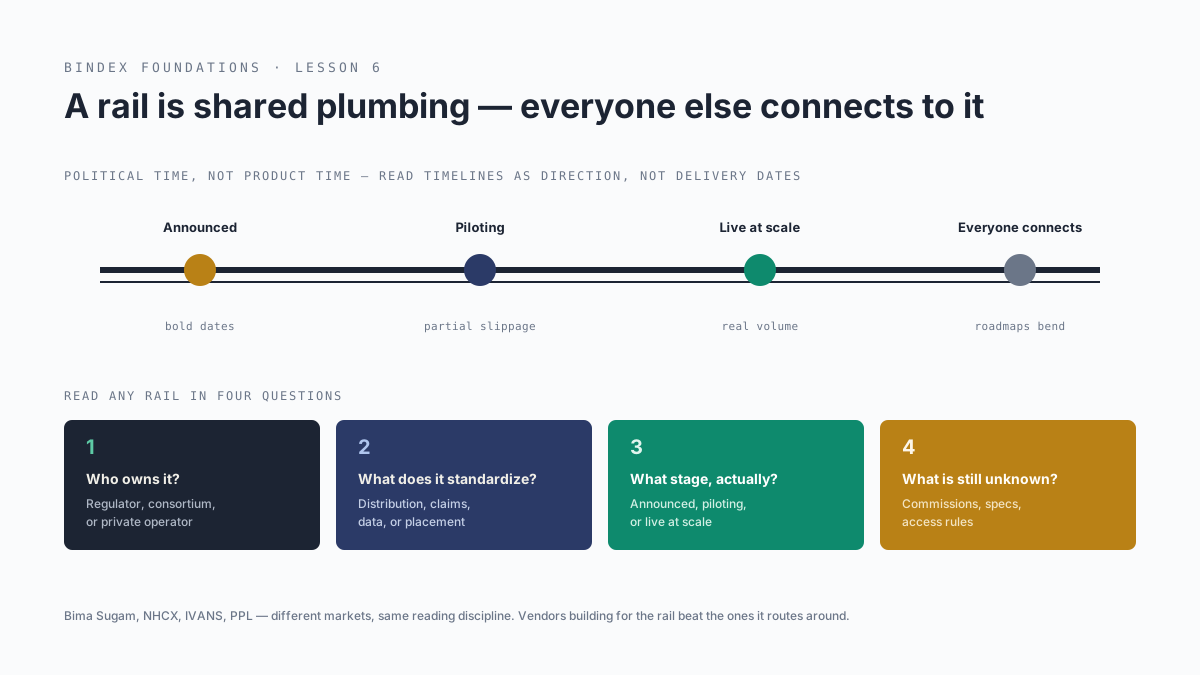
3. Rails move on political time, not product time. Rails are announced by regulators and industry bodies, which means ambitious dates and frequent slippage. A launch "targeted for end of September" is an intention, not a shipped system. Read rail timelines as direction and sequence, not as delivery dates, and treat any vendor claiming precise certainty about a rail's future as overconfident.
How to read a rail in four questions
When you encounter a market rail, answer these before assuming its effect:
- Who owns it? Regulator, industry consortium, or private operator? Ownership predicts incentives and pace.
- What does it standardize? Distribution, claims, data, placement? That tells you which vendors it touches.
- What stage is it actually at? Announced, piloting, or live at scale? Public digital infrastructure has a pattern: bold announcement, partial slippage, then real scale once live.
- What is still unknown? The commission model, the technical specs, the access rules. Honest analysis names the open questions instead of guessing them.
Using this in the index
Bindex tracks major market rails as listings in their own right, labeled as infrastructure rather than vendors, with the same freshness and provenance discipline as everything else. When you read a vendor's listing in a market with an active rail, look for how the two relate. The vendors building for the rail, and the vendors helping others connect to it, are usually better positioned than the ones a rail is about to route around.