A plain-language explainer of the Model Context Protocol — the standard plug behind the API-to-agent shift
If you have heard that AI agents are coming to insurance and want to understand the plumbing underneath that sentence, this is the lesson. No AI expertise assumed.
The definition
MCP stands for Model Context Protocol, an open standard introduced in late 2024 and since adopted across the major AI platforms. The plain version: it is a standard plug that lets AI assistants and agents call a piece of software's tools directly.
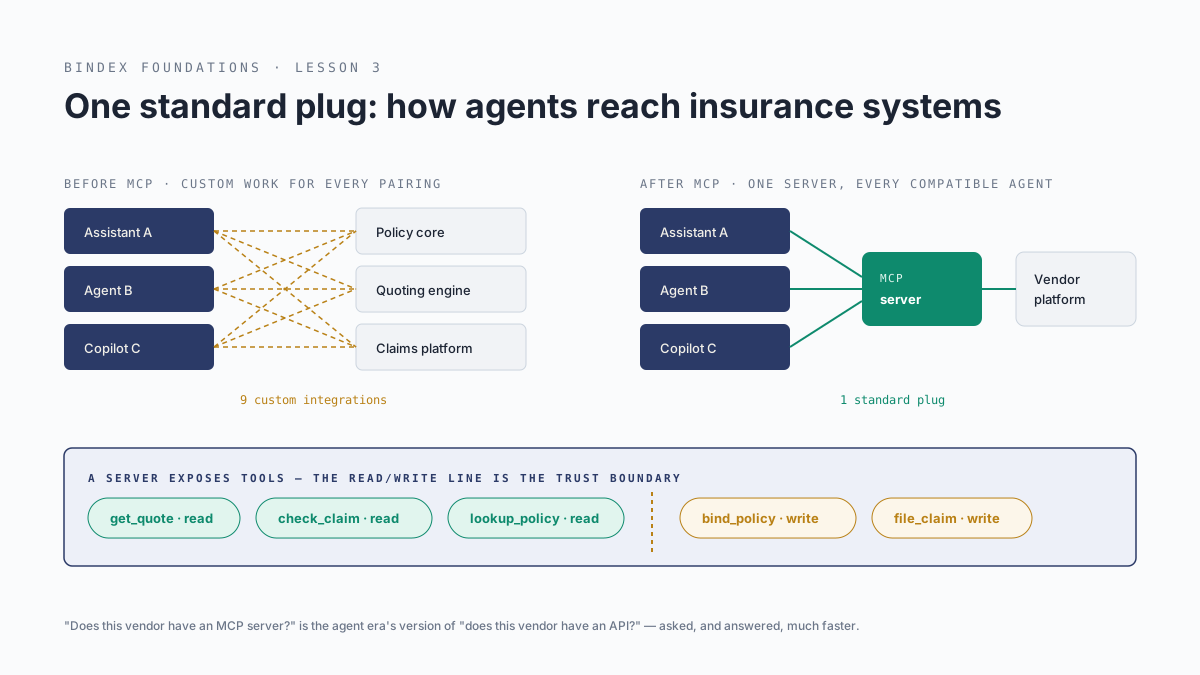
Before MCP, connecting an AI system to an insurance platform meant custom integration work for every single pairing — this assistant to that policy core, that agent to this quoting engine, rebuilt each time. After MCP, a vendor ships one MCP server and every compatible agent can use it. One plug, many agents.
What an MCP server actually exposes
An MCP server publishes tools: named operations an agent is allowed to call, each with a description the agent can read before deciding to use it. In insurance, the typical read tools are things like get a quote, look up a policy, or check a claim's status. Write tools — bind this policy, file this claim — exist too, and the line between read and write is the trust boundary that matters most when you evaluate one. A server that only reads can embarrass you; a server that writes can bind risk.
It helps to place MCP next to the thing it resembles. An API is how software talks to software; an MCP server is how an AI agent talks to that software. In practice an MCP server usually sits on top of a vendor's existing API, wrapping its surface in agent-readable tools. It does not replace the API — a vendor with a weak API rarely has a strong MCP server, because the server can only expose what the platform underneath can do.
Why insurance specifically
Insurance is an information business that still runs heavily on portals, PDFs and rekeying. Work that consists of reading documents, checking statuses and moving structured data between systems is exactly the work agents absorb first — which is why a standard plug into insurance systems matters more here than in industries that digitized their plumbing long ago.
The question "does this vendor have an API?" took roughly twenty years to become a standard procurement checkbox. "Does this vendor have an MCP server?" is the same question for the agent era, and it is being answered much faster. We watched the category go from zero servers to ten in ten months — the dated timeline, with the map and the gaps, is in our analysis of the category's formation.
What to check before you rely on one
Four questions separate a real MCP server from a press release:
- Which tools, exactly — and are they read or write? Ask for the tool list. The read/write split defines your risk.
- How is access scoped? An agent should authenticate with credentials that limit it to the tools you intend it to use, not a master key.
- Is there a sandbox? You want to watch an agent call the tools against test data before anything touches production.
- Is it maintained? An MCP server published once and never updated is a demo, not infrastructure.
These four are a preview of a longer discipline — the full checklist is the twelve questions for evaluating an insurance API, most of which apply unchanged to MCP servers.
Where to see the live picture
Bindex tracks every insurance MCP server we can find as listings with the same freshness and provenance discipline as everything else — the live count and the list are at the MCP tracker. When a listing in the index shows an MCP badge, this lesson is what that badge means.