bindex.

Foundations · Lesson 1 — The landscape

What is insurance technology, and how is it structured?

The beginner's map: carriers, brokers, MGAs, and the vendors who sell them software

Bindex Foundations · evergreen — updated in place · ~5 min read

Last reviewed 18 Jul 2026

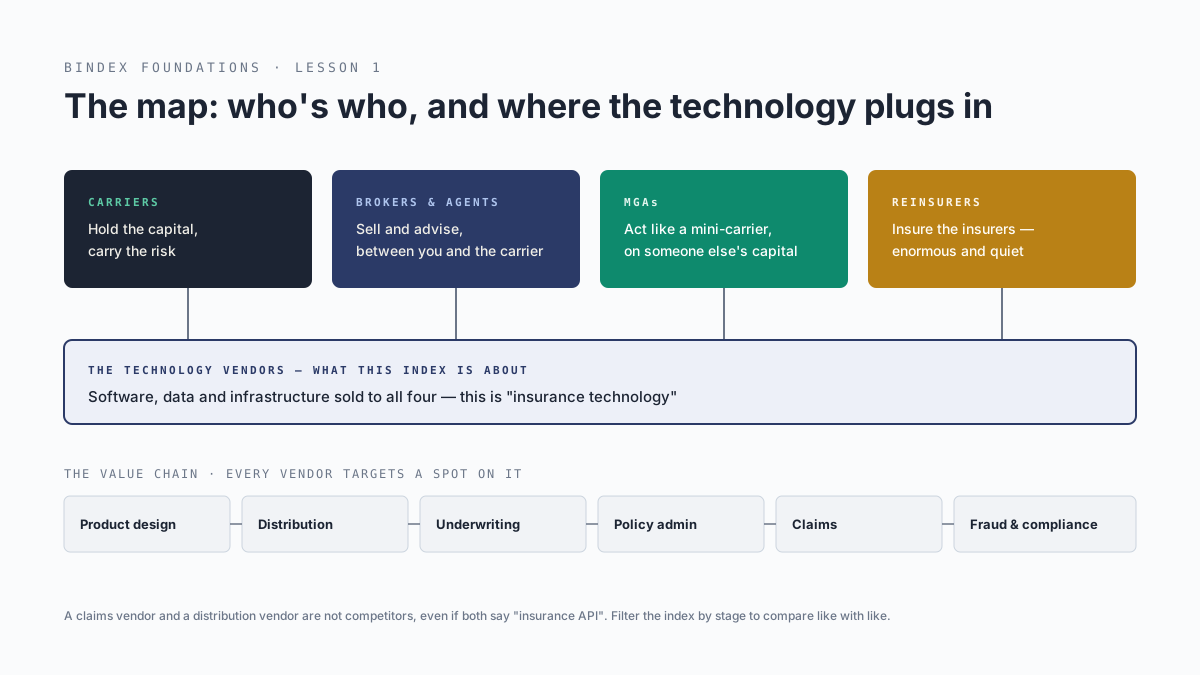
Illustration: What is insurance technology, and how is it structured?

If you are new to insurance technology, the first difficulty is that the word "insurance" hides at least four different kinds of company, and the software market makes sense only once you can tell them apart. This is the map. No prior knowledge assumed.

Who's who in insurance

Carriers (also called insurers or underwriters) are the companies that actually carry the risk. When you buy a policy, a carrier is the entity promising to pay your claim, backed by capital and regulated by the state. Think of the big names on stadium signage.

Brokers and agents sell and advise. They sit between you and the carrier. An independent broker represents you across many carriers; a captive agent represents one. They earn commission and increasingly run on their own technology stacks.

MGAs (Managing General Agents) are a hybrid that confuses newcomers: they act like a mini-carrier (designing products, pricing risk, handling claims) but do not hold the capital themselves. They operate on a carrier's balance sheet under delegated authority. Much insurtech innovation happens here, because MGAs can move faster than carriers.

Reinsurers insure the insurers. When a carrier wants to offload some of its risk, a reinsurer takes it on. This layer is enormous, quiet, and, as our research notes, almost untouched by modern APIs so far.

And then there is the layer this index is about: the technology vendors who sell software, data, and infrastructure to all of the above. That is insurance technology, or "insurtech" when the vendor is also a startup.

The value chain: where technology plugs in

Insurance is a sequence of jobs, and every vendor targets one or more of them. From front to back:

  • Product design, defining what a policy covers and how it is structured.
  • Distribution, getting insurance in front of buyers: agents, embedded checkouts, marketplaces, comparison sites. This is the most crowded technology segment by far.
  • New business and underwriting, quoting a price and deciding whether to accept the risk. Underwriting is where much of the AI money is going.
  • Policy administration, the system of record that manages a policy over its life. Often called the "core."
  • Claims, handling what happens when something goes wrong: filing, assessing, paying.
  • Fraud and compliance, running across all of the above.

When you read that a vendor offers a "claims automation API" or an "embedded distribution platform," they are naming their spot on this chain. A common beginner error is comparing two vendors that occupy different spots; a claims vendor and a distribution vendor are not competitors even if both say "insurance API."

What "API", "platform", and "MCP" mean here

An API (application programming interface) is how one piece of software talks to another. An insurance API lets a partner get a quote, bind a policy, or pull risk data programmatically instead of by phone or portal. A crucial distinction: a public API publishes its documentation openly (rare in insurance, about one in five), while a partner API exists but sits behind a sales conversation and a contract.

A platform or core is a larger system a carrier or MGA runs its operations on, often exposing many APIs.

An MCP server (Model Context Protocol) is the newest layer: a standard way for AI agents to call a vendor's tools directly. If an API is how software talks to software, an MCP server is how an AI assistant talks to that software. Insurance went from zero MCP servers in late 2025 to ten by mid-2026, which is why it has its own section in this index.

How to use this to navigate the index

Once you know the value chain, the index becomes a map you can read:

  • Filter by stage to see everyone doing the same job (all the claims vendors, all the distribution vendors).
  • Filter by market to see who operates where, since insurance is regulated country by country and a vendor "in Southeast Asia" may be licensed in only one of its markets.
  • Read the provenance labels on every record: "public sources" means we compiled it; "self-reported" means the company did. Nothing is presented as verified fact when it is a claim.
  • Check turnaround (instant, async, or days) and whether public docs exist before assuming an API fits your use case.

That is the whole foundation. Everything else in these Foundations builds on this map: how the agentic shift is changing the chain, how to evaluate a vendor properly, and how the picture differs by region.

Foundations teaches; the index applies.

Now explore the index →Read the latest analysis →

Cite this page

What is insurance technology, and how is it structured?. Bindex. https://bindex.dev/research/foundations/what-is-insurance-technology. Accessed 2026-07-21.

The Bindex Digest

What changed in insurance technology this week. New listings, new MCPs, funding, and the wire. Every Tuesday.

One email a week, unsubscribe anytime — privacy.

Foundations track